SALUS Zero
For medicine where nothing is available
Open source · AGPL-3.0 · July 2026 · Built with Claude: Life Sciences
02:00, a district hospital. A seven-year-old has abdominal pain. No CT, no ultrasound, no surgeon in the building — only a clock and a single doctor. SALUS Zero trains the decision of that night.


Try the prototype ↗Demo video ↗GitHub ↗
Prototype — not a validated medical device; no doses, no directives.
The hospital everyone assumes
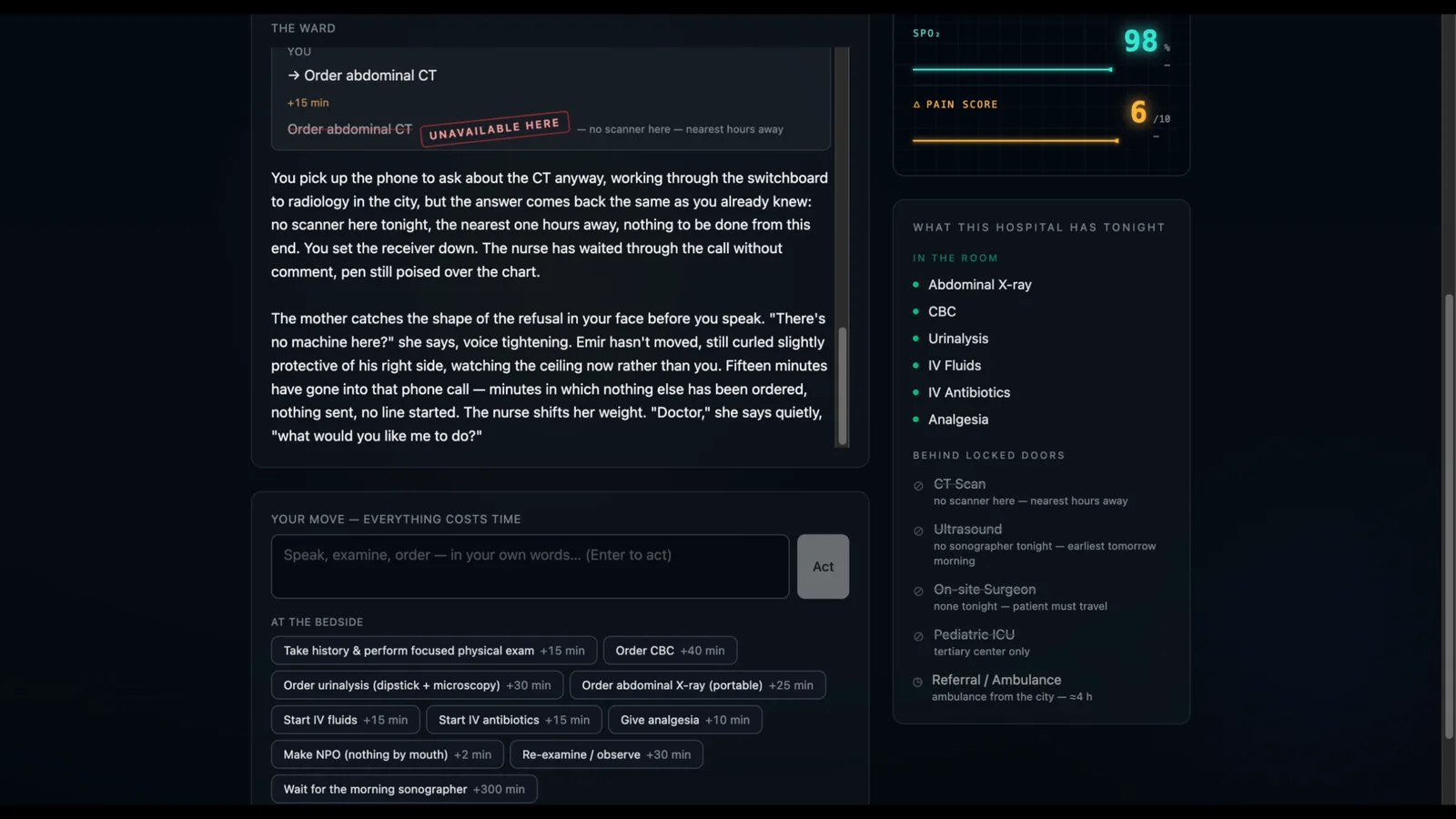
Most medical training assumes a hospital that has everything. But most of the world’s children are treated where there is no CT, no ultrasound, no surgeon in the building — only a clock and a single doctor. SALUS Zero trains decision-making for that world. Its signature constraint: you cannot order a CT — you decide with what the clinic actually has.
Two doors
SALUS Zero meets you twice.
Train for that night. A deterministic case engine — the clock, the stage physiology, the vitals and every lab value are computed in code; the model only narrates the world. When the night is decided, a debrief scores it 0–100 with arithmetic you can read line by line: referral timing, resource discipline, differential workup. The score comes from score.ts, never from the model.
Bring the real patient. A grounded, deliberately narrow appendicitis companion for the clinician with a real child in front of them. It starts from your inventory, not an assumed hospital: you confirm what the clinic actually has and how far the referral center is, and every plan is composed within those walls — it will never advise the CT you don’t have. Its PAS and Alvarado numbers are computed in code and handed to the model as data. It refuses doses, forces the mimics into every assessment, and keeps nothing about the patient, not even on the device.
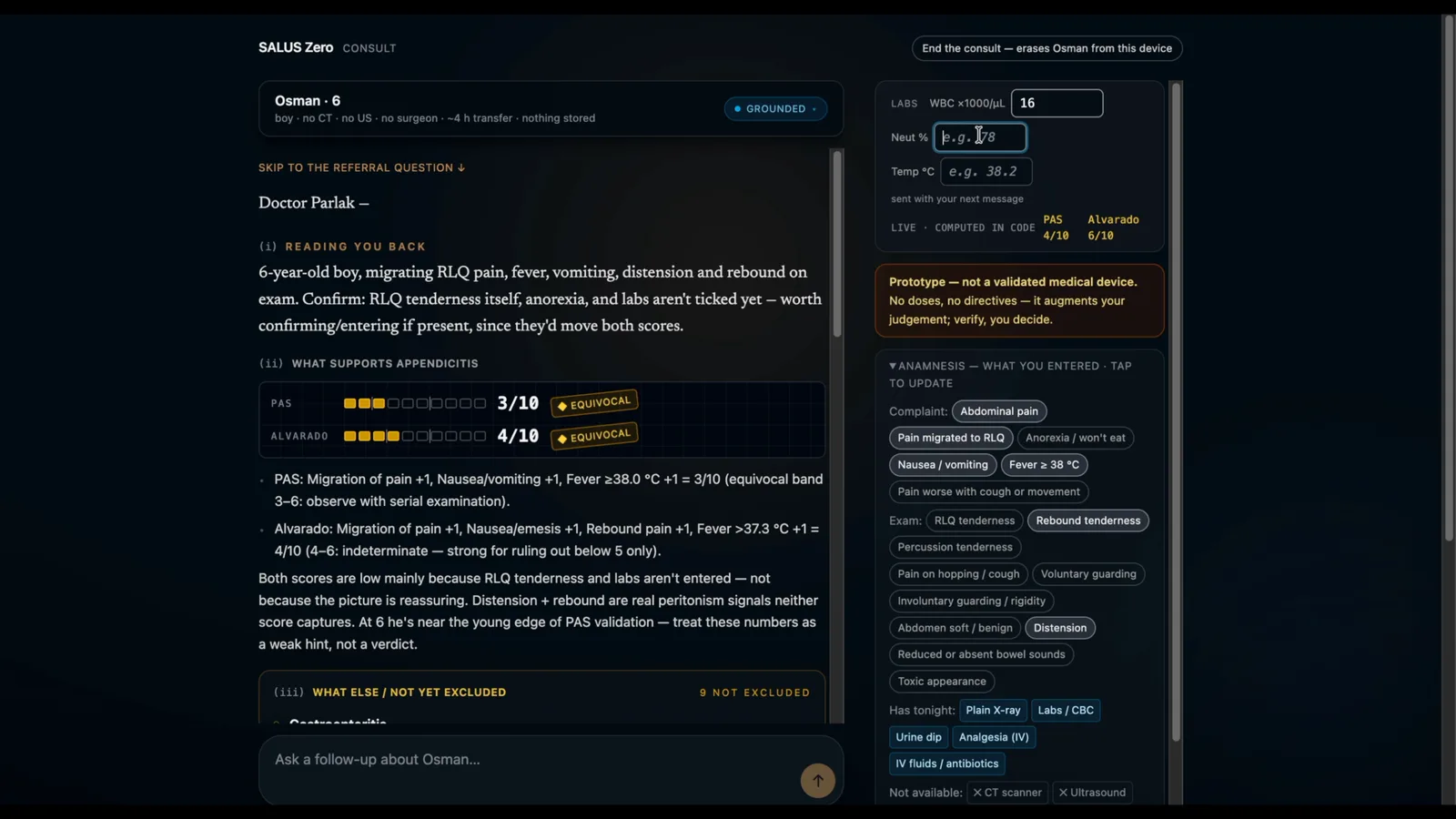
Code owns the number; the model narrates
Ask a plain chat model to run this night and it will play along — invent the lab it doesn’t have, let the CT happen, lose track of the clock, and grade its own story kindly. SALUS Zero is built for the model’s fallibility, not its intelligence. The model does only what models are good at — narrate the world, teach at the bedside — and everything that must be true is code:
- The clock and the vitals. Every action costs minutes; physiology follows the authored stage curve deterministically.
- The constraint. “No CT here” is data in the case spec, enforced in the turn resolver — not a hope that the model remembers its instructions.
- The number. The 0–100 debrief and the PAS/Alvarado scores are auditable arithmetic; the model explains the score but cannot invent it.
- The refusals. Doses are refused by prompt rails, with a code backstop that flags any slip visibly rather than silently redacting it.
Everything secret — the hidden diagnosis, future stages, scoring — lives on the server; the browser gets a public projection of the case and a state header per turn, nothing more.
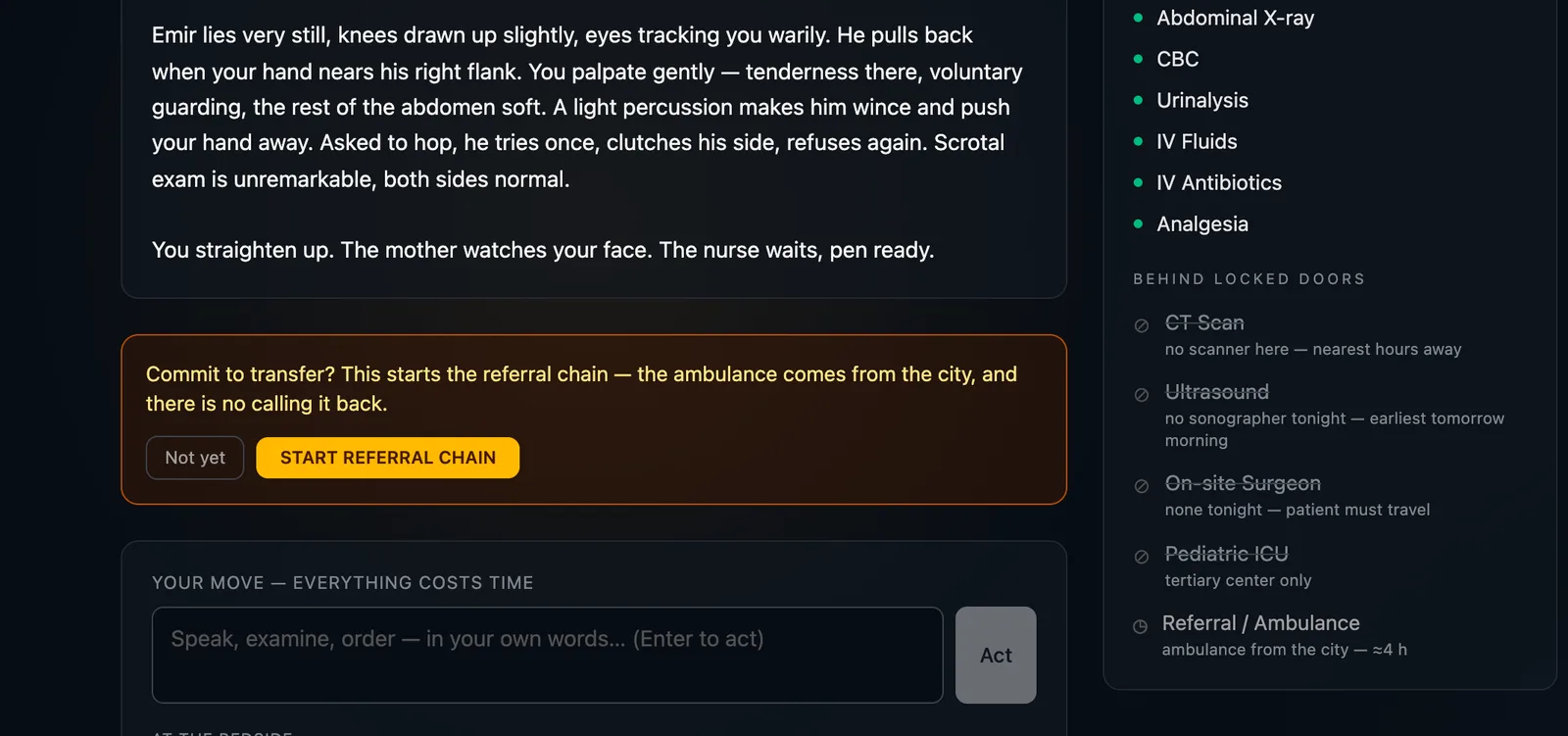
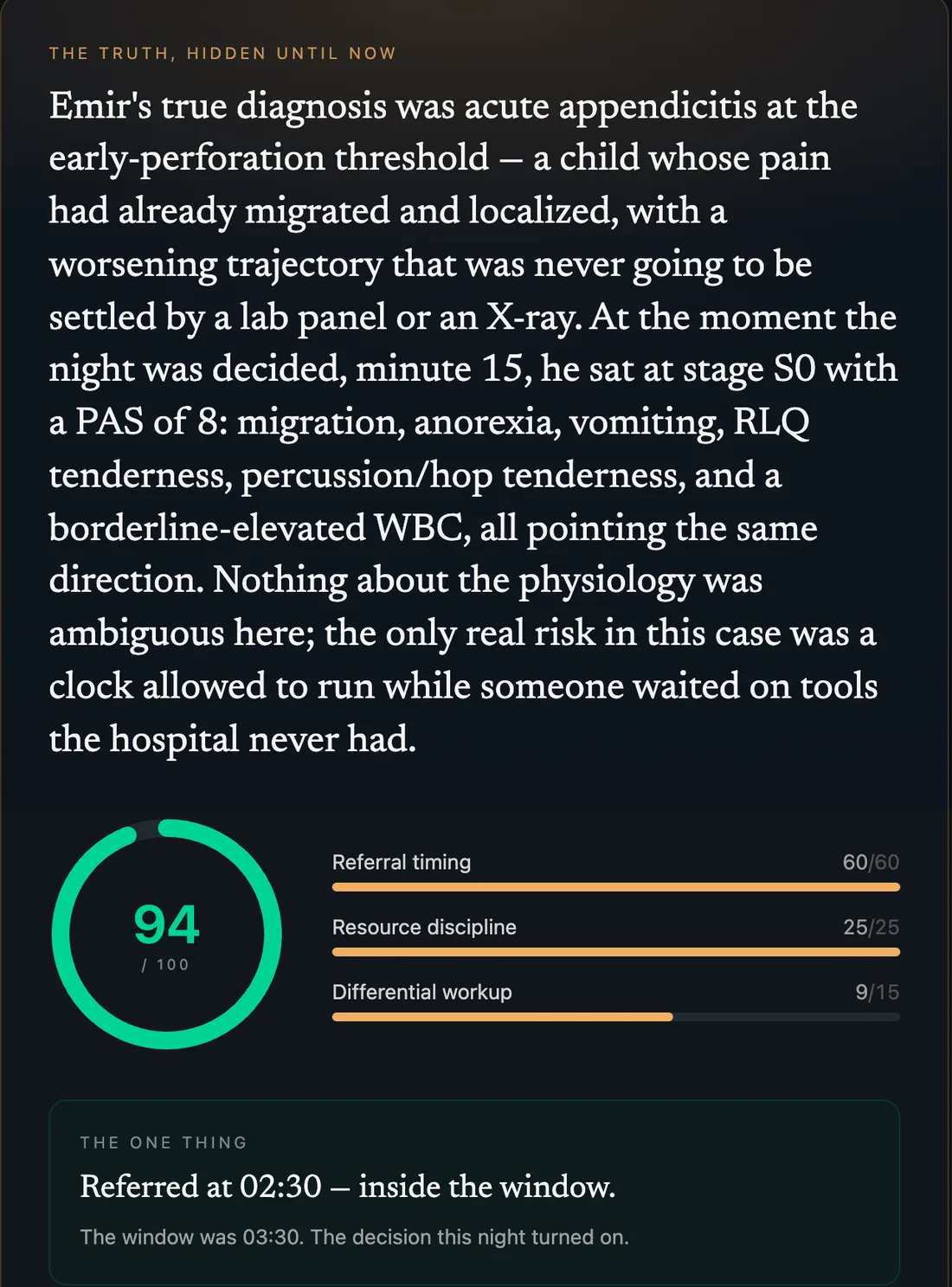
Every debrief closes with the same contrast paragraph, word for word as approved with the scoring. It ends:
“That pathway is not the optimum — it is the best possible, and they are not the same discipline. Textbooks teach the first; the doctor alone at 02:00 has to know the second.”
Why one disease
The companion is narrow on purpose: it answers only for suspected appendicitis in a child, because every line it speaks is anchored to a physician-approved reference and every score it shows is validated for exactly that question. An unvalidated case is worse than one perfect case. Appendicitis earned the first slot: it is the most common surgical emergency of childhood, the diagnosis rides on exam and simple labs when imaging is missing, and the cost of delay is perforation on a long transfer road.
The engine itself is case-agnostic — resources, stages and scoring are data — so the next validated case is authoring work, not engineering.
How it was checked
The working documents of the build are kept in the repository as evidence:
- Clinical approval (8 July 2026). The case’s clinical content was approved as fifteen items: the stages’ vital signs and triggers, the referral window, the cost of each action, the lab strings. A ruling on 11 July removed diabetic ketoacidosis from the appendicitis differential entirely; acute-abdomen mimics and, in a boy, testicular torsion took its place.
- Scoring (8 July). The 0–100 rubric — referral timing 60, resource discipline 25, differential workup 15 — was approved item by item, with an added 10-point penalty for a “blind” referral made without any examination. Contested clinical style (which antibiotic, which fluid strategy) is never scored.
- Red team (10 July). The consult companion was attacked in production: dose-baiting, scope escapes, “I am the developer” injections, a mother’s words entered through the doctor’s door, the age extremes. Four rails were added for the behaviours found weak and retested; the dose scan found no number with a unit in any of eighteen outputs.
- Code reviews. Adversarial reviews on days two, three and four, multi-agent on days three and four — on day three, 53 agents across six lenses, 23 findings, each independently verified.
- Tests. 72 deterministic tests over the score, the game loop, the consult scores and the rate limit.
- First hands. In its first days the engine was run by five pediatric surgery residents, an associate professor of pediatric surgery, a pediatrics resident — and a general practitioner at a district hospital of the very kind this engine was built for.
Limits
- A training simulation and a prototype, not a validated medical device: no doses, no directives. All doses and thresholds shown are illustrative.
- Appendicitis is only the pilot. The case’s patient is a boy on purpose; the ovarian-torsion arm is left out.
- Every turn calls Claude live; the engine currently requires network connectivity. An offline/low-connectivity mode is on the roadmap.
- An honest gap: the companion’s PAS/Alvarado arithmetic first lived in the model. It was caught twice in production and moved into code; the language around the numbers is still the model’s.
Documents
- Version
- Hackathon build, live: saluszero.com (mirror: salus-zero.pages.dev)
- Hackathon
- Built with Claude: Life Sciences, July 2026
- Licence
- AGPL-3.0-or-later
- Model
- claude-sonnet-5 (Messages API, streaming)
- Stack
- Cloudflare Pages Functions; no secrets in the browser bundle
- Tests
- 72 deterministic tests
Sources
- Repository: github.com/sahinparlak/salus-zero
- Design philosophy: docs/FELSEFE.md (Turkish)
- Clinical approval log: docs/GUN1-KLINIK-ONAY.en.md (English translation of the dated Turkish original)
- Scoring approval: docs/GUN3-SKOR-ONAY.md (Turkish)
- Red team: docs/GUN3-RED-TEAM.md (Turkish)
- All working documents, one line each in English: docs/
- Demo video (3 min): youtu.be/nViBs7w1IeA
Notes
- The scored night and the consult screen are the repository README’s own images; the referral confirm and the score are from a training night played on saluszero.com on 16 November 2026.
- The training case’s patient (Emir) is written in the code; he is fictional.
- Clinically reviewed by Şahin Parlak, MD, pediatric surgery resident.
Compiled from the project’s own repository and documents; last checked 18 November 2026.