Open Medical Baselines
Open medical data, made ready to use
Open source · MIT (code) · November 2026 · EVREN
Open medical data is usually ready to use — but not as you download it. This repository holds the scripts that built 19 of the 21 open datasets published on EVREN, Türkiye’s national AI platform, and evaluated all 13 of its baseline models.

Usually yes, but not as you download it
The article Is open data ready to use? tells how this work went and what it found. This page documents the repository behind it: what is in it, what every build checks, how the models were measured, and what it does not do.
Every dataset was taken from its original source with its license read there, split by patient, operation or near-duplicate group, and documented on its EVREN page — its “Kaynak ve türetim” (source and derivation) section lists the source, license, changes and split. Every published model has a full model card on EVREN. None of the models is a clinical tool.
What is in the repository
Code only: no images, signals, masks or model weights. For each dataset a build script reads the data you downloaded from its original source and placed where its docstring expects it, converts it, splits it and writes a build report; for each published model an evaluation script measures it again. Shared modules turn masks into polygons, run predictions with time-out handling and compute Dice, read a checkpoint’s best epoch and training settings, and download large files in resumable parallel ranges.
Beside the code are the decisions the builds depend on: the reviewed near-duplicate pairs of the two HyperKvasir sets, the 66 duplicate-signal records removed from Chapman-Shaoxing, the surgery splits of DSAD and the gastrectomy set, and the inter-annotator Dice of the DSAD labels.
Every build ends in checks
A build does not end by writing files; it ends by checking them, and stops if a check fails. The HyperKvasir polyp set, for example, must come out with 1,000 images and masks of matching sizes, 951 groups, no group in two splits, at least one polygon on every image, and a median Dice of 0.97 or more when its polygons are drawn back and compared with the source masks. The other builds check their own counts the same way — operations, patients, frames, and exactly the duplicates they drop, no others.
Near-duplicates are found by similarity; the unclear ones are decided by eye. In the HyperKvasir polyps, 441 candidate pairs were written down: 25 were decided automatically, 416 were looked at side by side — 386 different, 17 the same, 13 uncertain and grouped to be safe. The labelled HyperKvasir images have no patient or exam IDs, so frames of one exam can only be linked by similarity; the threshold was set after random pairs were reviewed by eye, and the stool classes were left out of the search, because stool-covered views of different patients look alike.
Measured again
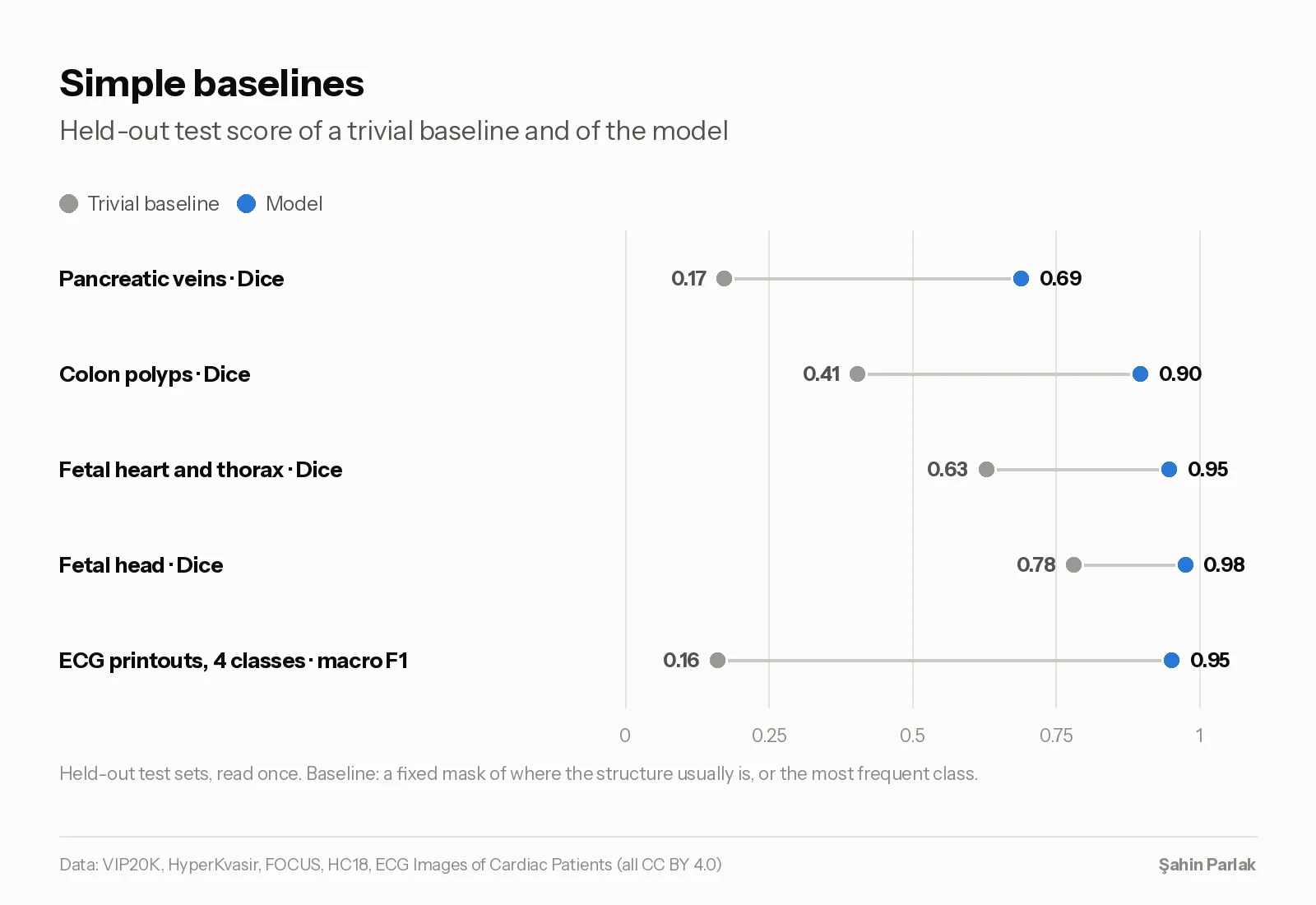
A platform’s training page is not the measurement. Every model was evaluated again against the original masks before a number was reported. Five of the thirteen were also compared with a trivial baseline that never looks at the image; every published model was trained twice with a different seed; and models were tested on another centre where the data allowed it. The numbers, and what they showed, are in the article.
The register
The 21 datasets by field; those with a published baseline model are marked.
- Surgical video
- VIP20K — veins in laparoscopic pancreatic surgery · model
LapGC-KVAD-30 — key vessels in gastric cancer surgery · model
Laparoscopic gastrectomy — organs and instruments · model
DSAD — anatomy in rectal surgery † - Endoscopy
- HyperKvasir — colonoscopy polyps · model
HyperKvasir — GI endoscopy, 23 classes · model
BM-BronchoLC — bronchoscopy landmarks and lesions - Ultrasound
- HC18 — fetal head circumference · model
FOCUS — fetal four-chamber view, heart and thorax · model
PSFHS — intrapartum, pubic symphysis and fetal head · model
PFUS1 — pelvic floor · model - ECG
- ECG Images of Cardiac Patients — 12-lead printouts, in two versions · model
PTB-XL — 12-lead superclasses, drawn from the signals · model
Chapman-Shaoxing — 12-lead rhythm, drawn from the signals · model - Angiography
- ARCADE — coronary artery segments (SYNTAX) · model
ARCADE — coronary stenosis · model - Microscopy
- MODUS — urine sediment, 40× · model
MODUS — urine sediment, 10×
VISEM-Tracking — sperm · model - X-ray
- GRAZPEDWRI-DX — pediatric wrist fractures †
† Built outside this repository.
Limits
- Not for clinical use. These datasets and models are for research and education; they are not validated for diagnosis, treatment or intraoperative guidance.
- The trivial baseline has been run for five of the 13 models; the other eight still need it.
- Similarity has limits: fetal ultrasound images of different mothers can look so alike that it cannot separate them, and stool-covered endoscopy views were left out of the search for the same reason.
- Two datasets are built elsewhere: GRAZPEDWRI-DX in a separate project, and DSAD, whose build depends on intermediate models that are not public.
- The scripts’ docstrings refer to the author’s working notes, which are not part of the repository; the same facts are on the EVREN dataset and model pages.
- The repository holds no data: each source must be downloaded from the original place named on its EVREN page.
Documents
- Code
- MIT; 36 Python scripts
- Data
- Each dataset keeps the license of its original source (CC BY 4.0 or CC0 for the sets here); cite the original authors as given on the EVREN pages
- Models
- AGPL-3.0 (trained with Ultralytics YOLO)
- Platform
- EVREN — the collection Sağlık: Açık Veri Setleri ve Baseline Modeller
- Environment
- Python 3.13 for local evaluation, versions in
requirements.txt; models trained on EVREN with its own Ultralytics build
Sources
- Repository: github.com/sahinparlak/open-medical-baselines
- The article: Is open data ready to use? (first published on LinkedIn, 10 November 2026)
- The collection on EVREN: evren.ssyz.org.tr/collections/…
Notes
- The figure and its numbers are the article’s own (10 November 2026).
- The HyperKvasir 23-class, PTB-XL and Chapman-Shaoxing models were published after the article, on 11–13 November 2026; the repository’s README does not list them yet. The article’s “13 models” is that day’s count.
- Every dataset’s EVREN page names its original source, license, changes and split; every model’s page carries its model card.
Compiled from the project’s own repository and documents; last checked 18 November 2026.